I thought it might be useful to put together a Pilates glossary to explain some of the words and phrases that I use in class.
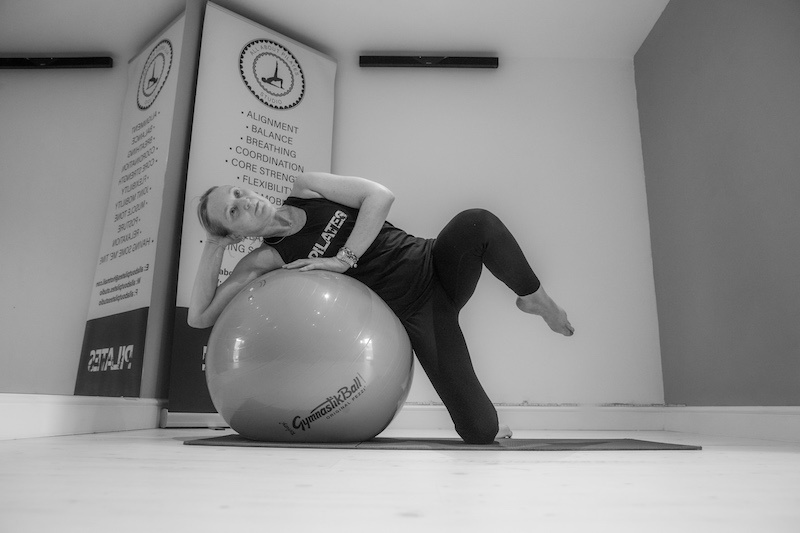
- SEQUENTIAL - used to describe spinal movements where the spine moves one vertebra at a time in a forwards, backwards and sideways direction. It is an important aspect of Pilates, balancing the front and back of the body in strength and flexibility, maintaining spinal mobility and postural realignment. Thinking of your spine as a string of pearls may help you to visualise the movement. Spine curl is an example of a sequential exercise.
- NEUTRAL SPINE - your spine is in neutral when all three curves are in correct alignment. In most cases, a neutral spine will be in the shape of the letter S with natural curves at the neck, upper and lower back. By maintaining a neutral spine you will move without causing damage or pain. Exercises like the pelvic compass, clock and spine curl will help you to recognise a neutral spine position.
- C-CURVE - this is used to describe the shape of your spine in some exercises, such as the Cat.
- PRONE, SUPINE AND SEMI-SUPINE - these are three positions that we use in Pilates. Prone is when you are lying on your front, supine on your back and semi-supine is more commonly referred to as relaxation position where you are lying on your back with your knees bent. You should be able to achieve all these positions with a neutral spine (see 2 above).
- CORE STRENGTH - in many cases, clients tell me their reason for doing Pilates is to build their core strength. Core strength isn't about building a six-pack or trying to achieve a flat stomach. It is about being able to move in a functional and safe way and involves the pelvic muscles, the deep abdominal muscles in your front and side and the extensor muscles in your back.
- PILATES STANCE - a position where your heels are connected and toes apart. It is a bit like first position in ballet. It works by activating the muscles from your seat bones to your feet and involves hugging the inner thighs together. The legs will be in a slightly turned out position.
- FUNCTIONAL MOVEMENT - I devoted a recent newsletter to the term functional movement, but in summary, it involves moving several muscle groups at one time to allow you to perform real-life movements such as picking something up from the floor. The emphasis is on core strength, stability, balance and coordination.
- DIMMER SWITCH - the dimmer switch is used to describe how much core strength you need to do a particular exercise. The harder the exercise, the more you will need to dial up the dimmer switch of your core muscles. For example, when you are doing the 100s with straight legs you will need to engage your core muscles far more than you would if you were doing a simple shoulder exercise in standing. If you over engage your core muscles at the easier levels you will have nowhere to go when the exercises get harder.
- ABDUCTION/ADDUCTION - when you take your arms or legs out to the side you are abducting them and when you take them back towards the body you are adducting them. Inner thigh squeezes use the adductor muscles and side-lying lift and lower of the top leg use your abductors.
- REST POSITION - similar to child's pose in yoga, rest position is most commonly used after completing prone extension exercises. You kneel with your bottom on your heels and your arms can be in front to the side or behind you with your head towards the floor. You can put less stress on your knees by putting a cushion in between your seat bones and your feet.
If there are any words or descriptions that you don't understand or would like me to explain in more detail, please email me and I will cover them in a future newsletter.


